Case study · Bahria Food Street
A website, a Flutter app and an admin panel in six weeks
An integrated restaurant platform for Bahria Food Street in Lahore: a production website, a Flutter mobile app and a central admin panel, delivered in six weeks.
- Client
- Bahria Food Street
- Role
- Full-Stack Web & Mobile Developer, Contract
- When
- May 2026 - Jun 2026
- Where
- Lahore, Pakistan / Remote
Overview
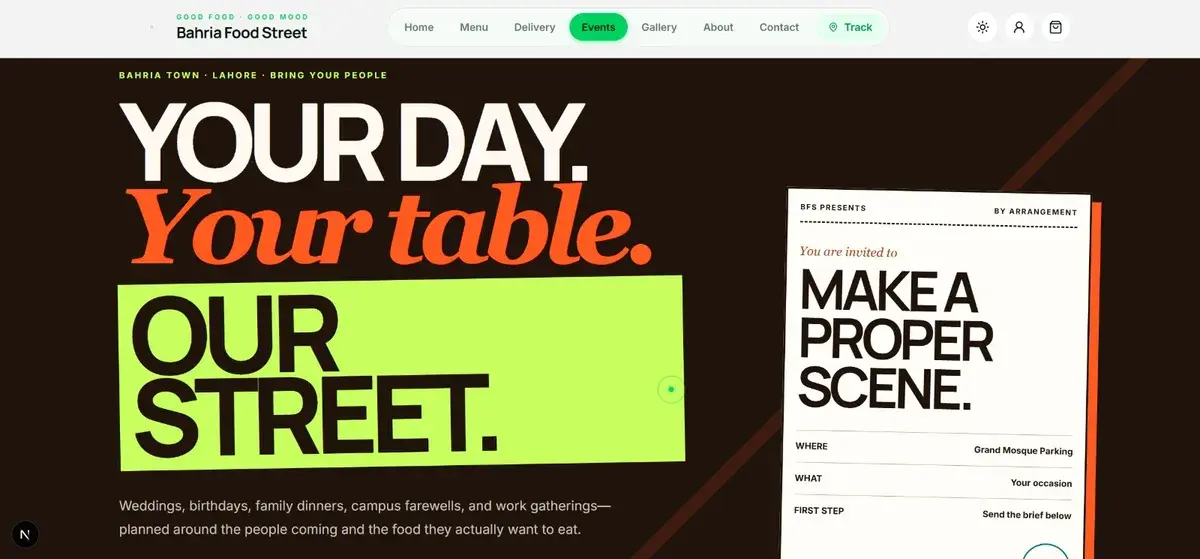
Bahria Food Street is a dining destination in Bahria Town, Lahore. I delivered its whole digital platform in six weeks: a production website, a Flutter mobile app and a central administration panel, all connected through shared APIs.
The website covers menus, visiting information with a map, event planning and order tracking. The mobile app brings an Uber Eats-style browsing experience to phones. The admin panel is where staff run menus, content, advertising, live orders, billing and reporting.
The challenge
Bahria Food Street needed one platform for customers on the web and on their phones, and one place for staff to run menus, orders and advertising, delivered on a tight six-week timeline.
Three products that share data can easily drift apart. A menu change or order status has to show up everywhere at once.
How it fits together
The website, the mobile app and the admin panel are three clients of the same REST APIs, so there is one source of truth. WebSockets push live updates such as order status.
Customers
- Next.js websiteMenus, visit, events, track order
- Flutter mobile appUber Eats-style browsing, Google Sign-In
Platform
- Shared APIsOne source of truth for all three products
Staff
- Admin panelMenus, content, ads
- Live ordersStatus updates
- Billing & reportsFinancial oversight
Key workflows
The processes the system runs, step by step. Amber steps are checks or gates; green steps are the outcome.
An order, end to end
Orders move through the admin panel's live orders view. Every status change staff make is pushed back to the customer, and the order ends with a printable receipt.
- 01Customer ordersWeb or mobile app
- 02Live orders viewAdmin panel, over WebSockets
- 03Status updatesPushed to the customer
- 04Printable receipt
One change, everywhere
Because every product reads from the same APIs, staff update a menu item or an advertisement once in the admin panel, and it appears on the website and in the mobile app.
- 01Staff edit menu or adAdmin panel
- 02Shared APIs
- 03Website + mobile app updated
What I built
Production website
The public website: menus, visiting information with a map, event planning and order tracking.
Flutter mobile app
An Uber Eats-style browsing experience with Google Sign-In.
Central admin panel
Menu and content management, advertising, financial oversight, live order status updates and printable customer receipts.
Shared APIs
The website, mobile app and admin panel all run on the same REST APIs, with WebSockets for live updates.
Results
- 6 weeks
- from start to a website, mobile app and admin panel
- 3
- products on one shared API
Stack
- Next.js
- JavaScript
- Tailwind CSS
- WebSockets
- Flutter
- Dart
- REST APIs
- Google Sign-In
Questions
- What does the Bahria Food Street platform include?
- A Next.js production website, a Flutter mobile app with Google Sign-In, and a central admin panel, connected through shared REST APIs and WebSockets.
Have a similar project?
I take on contract and full-time work from Muscat, Oman and remotely. Tell me what you're building.
Get in touch